
Where the footprint shows you volume, TPO shows you time. Each letter block marks one period of the session spent trading at a price. Stack the letters up and the session builds a profile: wide where the market accepted price and did business, thin where it rejected price and moved on. Traders use it to answer one question fast: where is value, and is price above it, below it, or inside it?
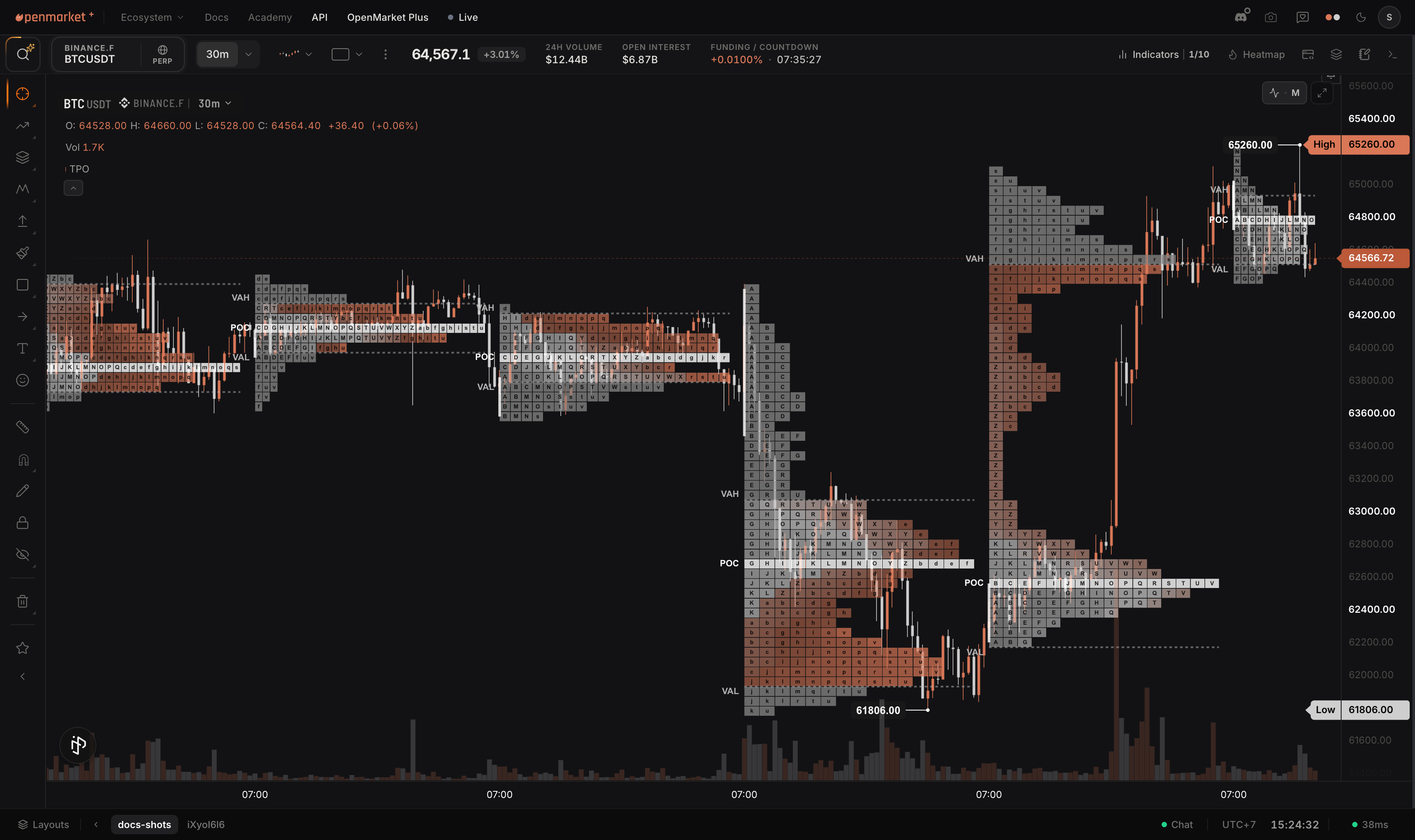
Add it to your chart
- Open Indicators in the top bar.
- Search for TPO and click it once.
- Each session renders as its own lettered profile alongside your candles.
The vocabulary, in one pass
- TPO: one Time Price Opportunity, one letter, one period of the session at one price. First period is A, second is B, and so on.
- POC (Point of Control): the price with the most TPOs, the fairest price of the session. OpenMarket outlines it on each profile.
- Value area (VAH / VAL): the band around the POC holding roughly 70% of the session's activity. Above VAH the market is exploring higher prices; below VAL, lower.
- Initial balance: the range of the first periods of the session. A session that never leaves it is balanced; a session that extends far beyond it is a trend session.
- Single prints: prices with just one TPO, left behind by a fast move. Thin structure that is often revisited.
- Poor high / poor low: an extreme where several periods stopped at the same price. The auction ended flat instead of with conviction, which is often read as likely to be repaired later.
How traders commonly read it
- Locate value first: above value, many traders read VAH as potential support on pullbacks; below value, the mirror reading applies. Inside value, the common reading is rotation between VAH and VAL.
- Judge acceptance vs rejection: price entering a prior value area and building letters there is acceptance (commonly read as rotation toward the far edge). Price poking in and leaving within a period is rejection.
- Mark poor structure: poor highs, poor lows, and single prints are levels Market Profile traders expect the market to revisit, and many use them as reference levels.
- Compare sessions: overlapping profiles mean balance and mean reversion; a ladder of higher value areas is read as trend, with the prior VAH as the common pullback reference.
Make it yours
TPO is the most configurable indicator on the platform, with roughly 80 options: letters or blocks, session choice and custom sessions, core levels (POC, VAH, VAL, mid), prior-session levels, structure markers (singles, poor extremes, initial balance), annotations, and an attached volume profile. The settings reference documents all of it, tab by tab.