
The IV smile plots implied volatility across strikes, up to three curves at once: the nearest expiry, the expiry closest to one week out, and the expiry closest to one month out. It answers the question candles cannot: how much movement is priced in, and in which direction is the market afraid?
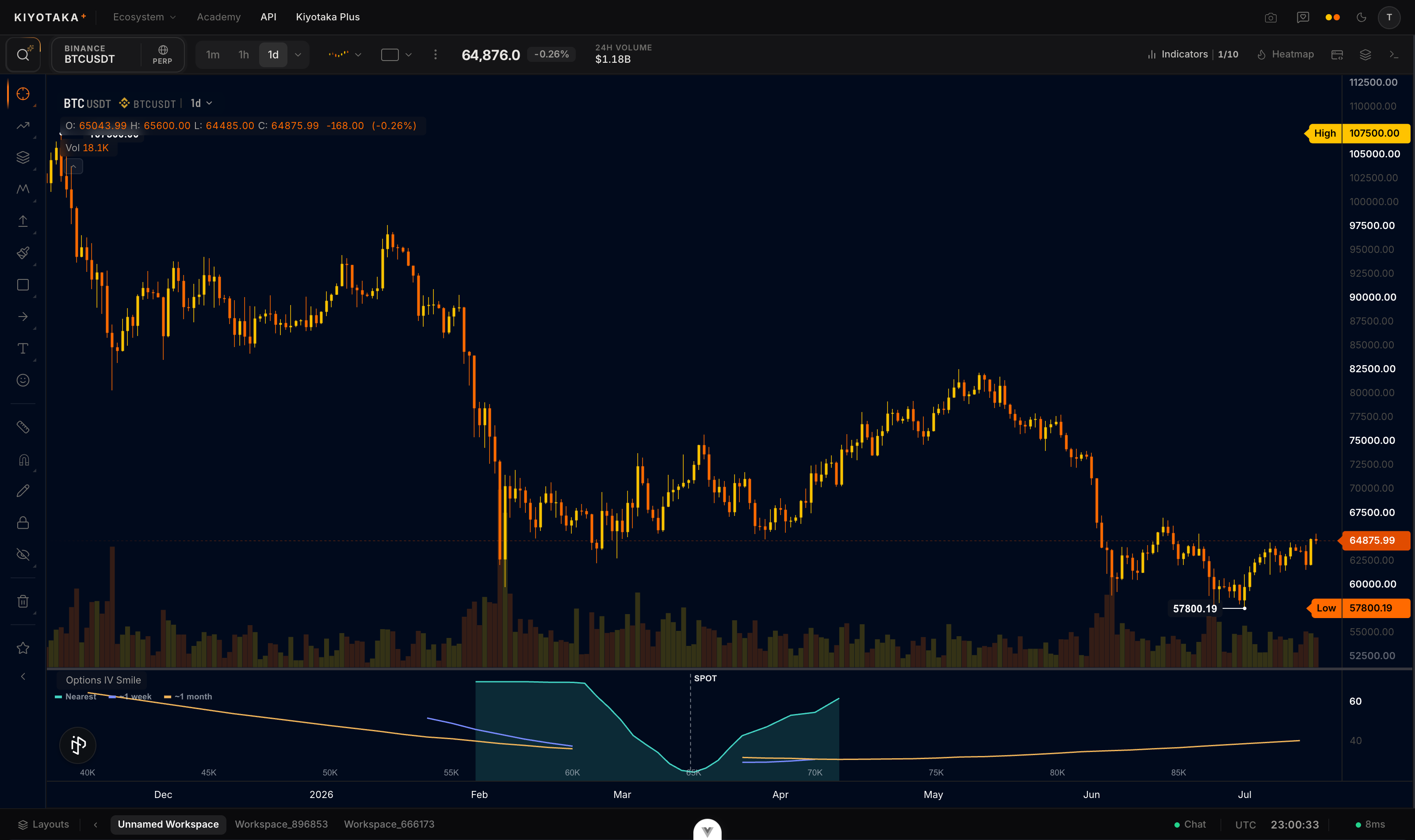
Add it to your chart
- Open Indicators in the top bar.
- Search for Options IV Smile and click it once. The curves render in their own pane, with strikes on the X axis.
Fullscreen
Use the legend's maximize button, or double-click the pane, to fill the chart with it; Esc restores the previous layout. Maximized, the smile plots every live expiry with its own date label instead of just the three horizon curves, with denser strike ticks and larger text.
How to read it
The name is literal: plotted IV usually curves up at both ends like a smile, because out-of-the-money options carry crash and squeeze premium. Read the shape three ways:
- The slope through the middle is the skew. Left side higher means downside protection is bid: fear. Right side higher means the upside is being chased.
- The curvature is the price of tails. A deep dish says the market pays up for big moves in either direction; a flat smile says tails are cheap.
- Front curve distorted, back curves calm: an event. Commonly read as the market pricing a date, not the world; such distortions often fade after the catalyst.
- All three curves shifted together: structural. The whole vol regime has moved, which is usually read as less likely to reset on one headline.
The X axis covers a percentage band around the current price (the strike window setting), so the smile stays centered on the market as it moves.
The math
Each curve is the venue's mark IV, stitched on the out-of-the-money side of that expiry's forward F:
IV(K)={IVput(K)IVcall(K)K<FK>F
Puts below the forward and calls above it are the liquid side of each strike, which is why the stitched curve is the cleanest one available.
The conventions page covers the stitching in full and how each expiry's forward is chosen.
Settings
| Setting | What it does | Default |
|---|---|---|
| Curves | How many horizon expiries to plot (nearest / about a week / about a month) | 3 |
| Strike window | How far from spot to plot, percent of price | 40 |
| Theme | Color theme for the pane: series colors, fills, and accents (six choices) | Aurora |
| Fill style | Area under the curves: none, soft, gradient, or by sign | Soft |
| Refresh | Poll cadence in seconds (30 to 600) | 60 |
Aurora reproduces the pane's original colors exactly. The three curves are colored as one hue fading from the nearest expiry (full color) to the farthest (faintest); Ice Fire additionally tints each curve by side of spot, cooler below the spot marker and warmer above it.
Assumptions
- Curves come from the shared live options chain snapshot, refreshed on the pane's own poll (default 60 seconds), not a tick-by-tick feed.
- On a coin with both a coin-settled and a USDC-settled options book, the smile reads only the deeper of the two so the curve never mixes pricing conventions.
- A horizon whose closest live expiry is already claimed by an earlier curve is dropped rather than duplicated, so you can see fewer than three curves when listed expiries are sparse.
Reading it in context
- The front smile's put wing before an event. Steepening means protection is being paid up for, positioning that can be visible before the headline lands.
- A smile that flattens after a selloff means fear is being priced out, which some traders read as selling pressure easing.
- Which horizon carries the distortion. An ugly front smile with calm back curves points to a dated event; all three ugly points to a broader regime shift.
- Skeptical caveat: the far wings are thin. A handful of tiny quotes can print jumpy IVs at the extreme strikes, so trust the shape near the money more than the last point on each end.